
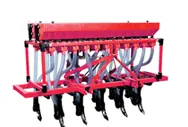
Quick answer: Choosing between a zero till drill and a Happy Seeder for wheat sowing after paddy starts with the residue left in your field. A suitable zero till drill may work where residue is manageable. A Happy Seeder is designed to sow into rice residue while managing straw. Check the actual machine model, field conditions and tractor compatibility before booking. Neither option is automatically best for every farm.
Prefer Hindi? Read this guide in Hindi — हिन्दी में पढ़ें.
This guide helps farmers compare equipment for the rice–wheat rotation in northern India. Use your local KVK and ICAR-IIWBR wheat crop advisory for region-specific sowing dates, varieties and crop management.
What is the difference between a zero till drill and a Happy Seeder?
A zero till drill places seed through narrow openings in the soil without preparing the entire field through repeated tillage. Its suitability depends on opener design, residue load and soil conditions. A conventional seed drill intended for a prepared seedbed should not be assumed to have the same capability.
A Happy Seeder combines residue handling with direct sowing. It can establish wheat in rice residue without burning it when the equipment and field are suitable. ICAR describes it among alternatives to crop residue burning. This does not mean every model can handle every straw condition.
Which machine suits your field?
- Limited, evenly spread residue: ask for a zero till drill demonstration and inspect seed placement.
- Substantial rice residue: compare a suitable Happy Seeder or another residue-management sowing option.
- Straw heaps or uneven spreading: agree how the residue will be managed before sowing. A pile and an even mulch are different operating conditions.
- Waterlogged or very wet soil: seek local field advice before starting simply because a machine is available.
- Small or divided plots: include access, turning space, transport and minimum booking charges in the comparison.
Treat this as a decision checklist. A field demonstration gives you more useful evidence than choosing by the machine name alone.
Will the implement work with your tractor?
Engine horsepower is only one check. Confirm the exact implement’s power requirement, PTO requirement where applicable, hitch arrangement, lifting capacity and operating instructions in its manufacturer manual. Working width and row count can change requirements. Give the provider your complete tractor model and ask for written confirmation before payment.
Explore our tractor collection and farm equipment section. Confirm current stock and compatibility with the team.
How to compare the actual rental cost per acre
Cost per acre = (machine and tractor hire + separately charged fuel or operator + transport + necessary extra field preparation) ÷ acres sown.
Do not count costs twice if the hire quote already includes them. Compare quotes for the same area and the same services. Agree the area in acres or hectares first, because the size of a local bigha can vary.
Illustrative calculation, not a market price: a complete ₹6,000 quote for four acres works out to ₹1,500 per acre. A ₹5,600 quote for the same four acres is ₹1,400 per acre. The ₹100 difference is only one factor: suitable equipment, timely availability and sowing quality also matter.
If seed and fertiliser are identical in both options, list them separately. If the products or quantities differ, include that difference in your total comparison. Do not treat savings reported in an older trial as a guaranteed saving on your farm.
Eight questions to ask before booking
- Will this exact model work with my residue and soil conditions?
- Can I see it operating in a similar field?
- Does the quote include the tractor, fuel and operator?
- Are transport, waiting time or minimum-area charges extra?
- Which date are the machine and operator available?
- Who will check seed-rate calibration and sowing depth?
- What happens if the machine blocks or breaks down?
- Which area unit and payment terms does the quote use?
What should you check when sowing begins?
Start with a small trial section. Have the trained operator stop and secure the machine before checking seed position, depth and distribution across rows. Resolve blocked outlets, uneven delivery or seed trapped in straw before proceeding across the whole field. Follow the manufacturer instructions and local crop recommendations when setting seed and fertiliser rates. Never clear a blockage while moving parts are operating.
Frequently asked questions
Can wheat be sown after paddy without ploughing?
Yes, in suitable fields with an appropriate direct-sowing machine. Skipping full tillage still requires suitable equipment, calibration and field checks.
Can an ordinary zero till drill work in heavy paddy straw?
Do not assume it can. Residue quantity, distribution and the machine’s design matter. Ask for a demonstration under comparable conditions.
Are Happy Seeder and Super Seeder the same?
No. Their working methods and handling of soil and residue differ. Compare the actual model manuals and field results rather than using the names interchangeably.
Is burning paddy residue necessary before sowing wheat?
No. Suitable residue-management and sowing systems provide alternatives. Discuss a workable plan for your field with a local agricultural specialist.
How much tractor horsepower is required?
There is no single figure for every implement. Check the exact model’s power, PTO, lifting and hitch requirements with the manufacturer.
When should wheat be sown after paddy?
Follow current advice for your region, variety and irrigation situation. A single sowing date for all of India would be misleading.
Will zero tillage always reduce diesel use and costs?
Fewer tillage passes can create savings, but hire charges, extra preparation and operating conditions affect the result. Calculate from complete quotes for your own field.
Should a small farmer buy or rent the machine?
Compare annual use, purchase and maintenance costs, transport, and whether reliable rental equipment is available on time. Renting may suit occasional use; ownership needs a realistic annual-cost calculation.
How much subsidy is available?
Eligibility, application windows and assistance depend on the current scheme and state. Verify with the relevant agriculture department before budgeting on any promised subsidy.
Your next step
Write down your field area, residue condition, tractor model and intended work date. Get two complete quotes and arrange a field demonstration. Browse Dev Shakti’s equipment or call +91 80091 67772 to discuss options and confirm availability.
Sources and editorial note
Written by Dev Shakti Group. Technical references: ICAR on alternatives to residue burning, ACIAR research on zero till and Happy Seeder, and ICAR-IIWBR crop advisories. This is the English companion to our existing Hindi guide. Rental figures are calculation examples, not quotations. Questions reflect practical farmer decisions and are not presented as verified Google Trends rankings.
The cover shows a representative seed drill, not a specific Happy Seeder or zero till drill model.